Beaches are full of life
Linda R. Harris 
Meet the residents
If asked to name animals that live on the beach, many would list turtles and perhaps some of the shorebirds - like seagulls, terns, sanderlings and plovers. Indeed, sea turtles lay eggs in carefully dug nests on beaches, and shorebirds feed and nest on beaches too. Although some of these vertebrate animals are found on beaches year-round, many are migratory species that use beaches seasonally. The biggest community of local residents on beaches are made up of invertebrate species - animals without a backbone.
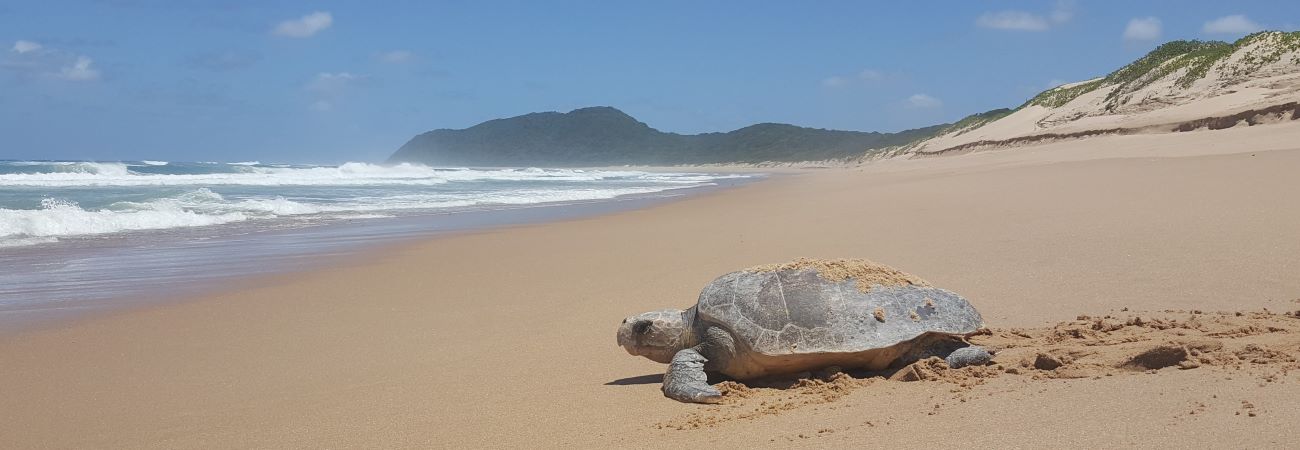
Ranging in size from about 1 mm to 10 cm, there are hoards of macrofauna species that live on beaches year-round. These include surf shrimps, plough snails, clams, mole crabs (sea lice), worms, sand piranhas, beach hoppers, beetles, and roly-polies (pill bugs). Ghost crabs are probably the largely resident invertebrates on most beaches, with adults growing well over 10 cm in size if you include their legs in the measurement.
Adaptations for survival
Although it sounds idyllic to live on the beach, when you are such a small animal, each wave is like a tsunami, threatening to wash them out to sea! If they remain on the surface of the sand, it can get incredibly hot in the midday sun (as many of us have experienced!). This is why most beach animals spend the majority of their lives buried in the sand.
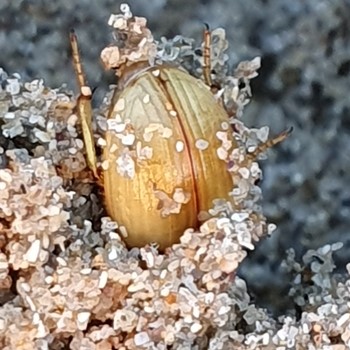
Beach animals can burrow with different levels of ease and speed. Among the fastest burrowers are mole crabs (also known as sea lice, although they are actually crabs, not lice). If you’re able to catch one and place it down in the wet sand, it disappears in the blink of an eye. Other species take longer to burrow, like the beetles, sand hoppers, and roly-polies (also known as pill bugs, although they are isopods, not bugs). If the animals live within reach of the waves, and their burrowing time is longer than the time between successive waves, they will be washed away and won’t be able to survive on that particular beach.
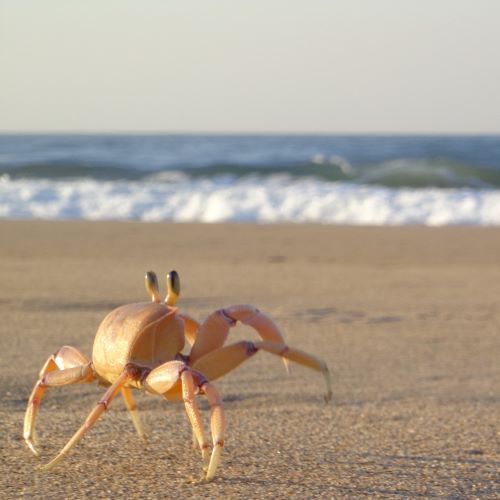
Beach animals must have a way to swim, surf, jump, run or crawl. The sand and surf is in constant motion, and beach animals need a way to ‘go with the flow’ to escape predators, and find food and mates. Plough snails use their large foot like a surf board to surf in the swash, and can also it to crawl on wet beach sand. Sand piranhas crawl on the sand, and are very fast swimmers, emerging out the sand to hunt when submerged by the incoming tide. Sand hoppers and pymy mole crickets hop or jump to move around, and ghost crabs can use their many legs to reach top speeds as they run across the shore.
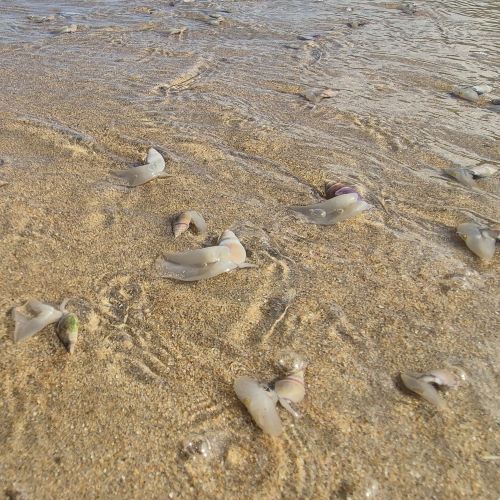
Beach animals need to move with tides. To maintain their relative position on the shore, beach animals need to migrate across the shore with the tides, or else they must live in cycles where they are periodically submerged under water. Plough snails continually surf in the swash to ensure they stay in the dynamic wet edge of the sea. Clams also migrate with the tides, using the vibrations on the shore from breaking waves as a cue to emerge out the sand and surf using their foot, although much less efficiently than the plough snails because a clam’s foot is better suited to burrowing and anchoring in the sand.
Very specific habitats
Because beach animals have to be so specialised to deal with the dynamic physical environment around them, they tend to have very specific habitats in which they live. Most species live either on the low shore, midshore, high shore, or above the high-tide mark. They also tend to live on only one or two of the beach morphodynamic types1, and in one or two biogeographic regions.
1 Beach morphodynamic types refers to the different types of beaches that form as a result of the interaction between tides, waves and sand. They range from dissipative, through intermediate, to reflective types on wave-dominated, microtidal shores. Click the link to learn more.
This means that many beach animals in South Africa are found only on our west (Southern Benguela), south (Agulhas) or east coasts (Natal-Delagoa), in a specific zone on a subset of the beaches in that region. These very specific habitat requirements makes them susceptible to impacts from a variety of pressures, like coastal development, mining, removing wrack (washed up kelp and seaweed) and pollution because they often can’t survive anywhere else than right where they are.
This also means the responsibility to look after many of the species is entirely up to us in South Africa because these animals occur here and nowhere else on earth.
Visit the Sandy Beaches (s Afr) project on iNaturalist to view some of the beach species that you can find in southern Africa, and Sandy Beach Invertebrates (Global) project to look for beach species found elsewhere in the world.
Next time you go to the beach, see if you can spot some of these interesting animals.