Beach life on the red list
Linda R. Harris 
What is the red list?
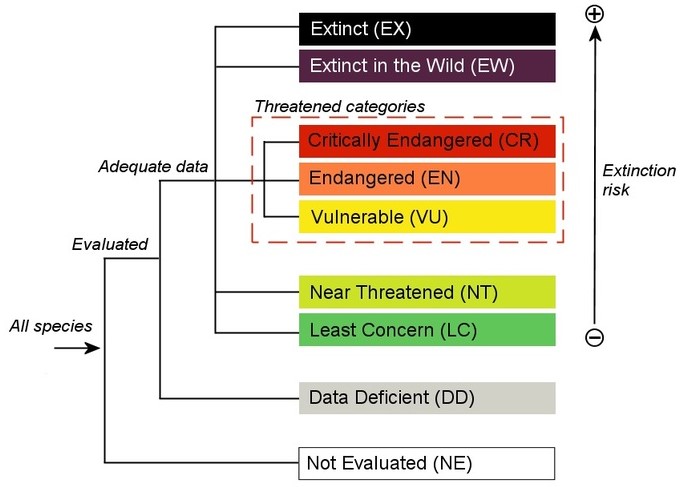
The IUCN maintains a Red List of Species based on assessments of how close a species is to extinction. The assessments allow scientists to categorise species into one of nine categories, depending on whether the species has been assessed, if there is adequate information to complete an assessment, and the level of extinction risk. The collective term for species that are Critically Endangered, Endangered and Vulnerable is ‘threatened’.
First ever red list assessments of beach invertebrates
Recently, the first ever red list assessments were undertaken for sandy beach invertebrates. There were 20 species that were selected to be assessed. Most of these species occur only in South Africa, some extend into Namibia or Mozambique, and only the four crabs and one clam (Latona madagascariensis) have broader distributions.
A database of species occurrences was compiled from iNaturalist, GBIF, and field sampling to calculate the area of occupancy (AOO1) and extent of occurrence (EOO2) of each of the species using the GeoCAT tool. These metrics, data from past research, and expert knowledge were used to assess the species using the IUCN Red List Criteria and Categories.
1 AOO: The area occupied by a species, calculated using a standard 2x2 km2 grid
2 EOO: The total area within which a species occurs, measured as a minimum convex polygon around all localities
Red list assessments
The species that were assessed are pictured below. You can click on each of the pictures to view the full IUCN Red List of Species assessments.
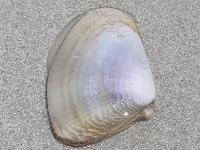
Donax serra EN
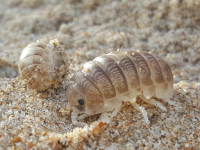
Tylos capensis EN
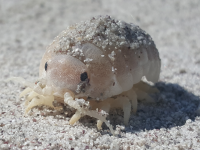
Tylos granulatus EN
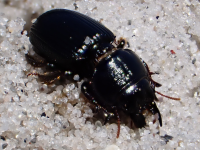
Acanthoscelis ruficornis EN
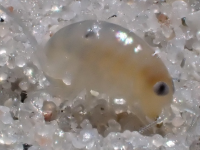
Africorchestia quadrispinosa NT
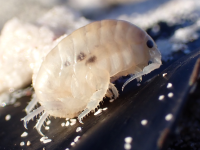
Capeorchestia capensis NT
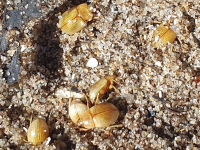
Pachyphaleria capensis NT
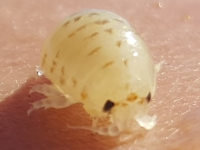
Excirolana latipes LC
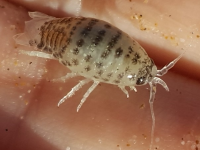
Excirolana natalensis LC
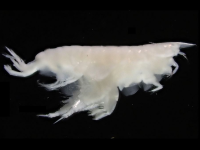
Griffithsius latipes LC
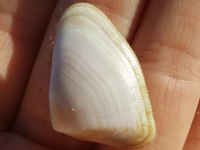
Latona sordida LC
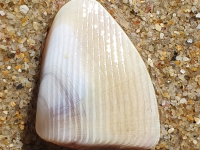
Latona madagascariensis LC
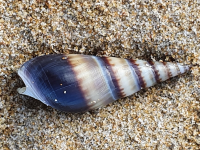
Bullia digitalis LC
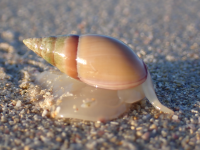
Bullia rhodostoma LC
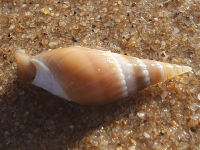
Bullia natalensis LC
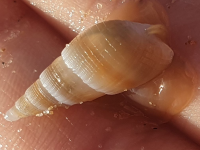
Bullia mozambicensis LC
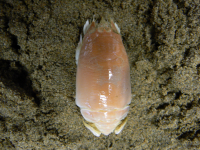
Emerita austroafricana LC
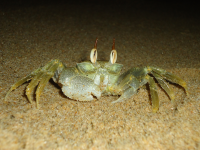
Ocypode ceratophthalmus complex* LC
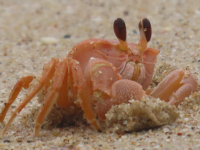
Ocypode madagascariensis LC
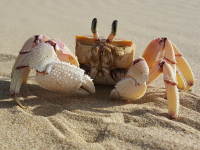
Ocypode ryderi LC
*Since the assessment of Ocypode ceratophthalmus, the species has been subsequently split into three different species (Davie et al. 2026). This means the assessment is of the Ocypode ceratophthalmus complex. The species pictured above is Ocypode celadon, which was described as a new species as part of the taxonomic revision.
Species most at risk
Seven of the 20 species assessed are threatened or Near Threatened. The species that are most at risk are the Endangered white mussels (Donax serra), pillbugs (Tylos capensis and Tylos granulatus) and beach ground beetle (Acanthoscelis ruficornis). Click on each of the boxes below to find out why the species are threatened or Near Threatened.
Endangered species
Donax serra (white mussel) is a beach clam that is endemic to Namibia and South Africa. There is evidence of population declines by 50-80% based on commercial catch and catch per unit effort (CPUE) data in South Africa over the past 10 years, disappearance of the species at sites that have been mined in Namibia, and anecdotal evidence of severe declines and/or disappearance of the species at certain beaches in South Africa. Harmful algal blooms can also cause mass mortalities. The overall population is suspected to have declined by over 50% in the past decade and it is therefore assessed as Endangered under Criterion A2.
Tylos capensis (Cape calloused beach pillbug) is endemic to South Africa. It has a limited range and restricted habitat along the South African south coast, with between 9 and 12 locations extant. It is experiencing ongoing loss, degradation and fragmentation of habitat to expanding coastal development and artificial light at night (ALAN), and has been lost from at least four locations, including inside protected areas. This species broods its young, has small broods and limited connectivity, and has been assessed as being severely fragmented based on the IUCN definition. It therefore qualifies as Endangered under Criterion B.
Tylos granulatus (granulated calloused beach pillbug) is restricted to the coast of Namibia and South Africa. It generally occurs in low numbers, and is found in large abundances (hundreds to thousands of individuals) in only a few places. Extirpations have been recorded at the southern end of its range due to coastal development, there are no recent records in the northern part of its range, and it is impacted by mining. Kelp wrack removal takes away an important source of food for this species. Collectively these pressures are causing notable declines in its habitat availability and quality, and declines in the number of mature individuals. This species broods its young, has small broods and limited connectivity, and has been assessed as being severely fragmented based on the IUCN definition. It therefore qualifies as Endangered under Criterion B.
Acanthoscelis ruficornis (beach ground beetle) is a southern African endemic species, found only in the supralittoral habitat on sandy beaches along the west coast of South Africa and Namibia. It burrows in the sand or hides under kelp wrack, feeding on invertebrates associated with wrack. Approximately 80% of its recent (since 2000) range is exposed to mining, coastal development and/or kelp wrack removal. These pressures are causing declines in habitat extent, quality, and population abundance, and there is evidence that the species has been lost from some sites that have been mined. The population is inferred to be severely fragmented, comprising small, isolated subpopulations across its range. It is therefore listed as Endangered under Criterion B.
Near Threatened species
Africorchestia quadrispinosa (four-spined sandhopper) is endemic to southern Africa, and is found only on beaches with beach-cast wrack on the south/west coast of South Africa and Namibia. It is experiencing ongoing loss, degradation and fragmentation of habitat to coastal mining, wrack removal and coastal development. This species broods its young, has small broods and limited connectivity. However, where their habitat is intact, subpopulation sizes are large. Therefore, despite limited connectivity, the population does not qualify as severely fragmented based on the IUCN definition. It therefore qualifies as Near Threatened under Criterion B.
Capeorchestia capensis (Cape sandhopper) is endemic to South Africa. It has a limited range and is restricted to beaches with wrack along the South African south-west coast. It is experiencing ongoing loss, degradation and fragmentation of habitat to coastal mining, wrack removal and coastal development. This species broods its young, has small broods of 1-9 individuals and limited connectivity. However, where their habitat is intact, subpopulation sizes are large. Therefore, despite limited connectivity, the population does not qualify as severely fragmented based on the IUCN definition. It therefore qualifies as Near Threatened under Criterion B.
Pachyphaleria capensis (Cape beach darkling beetle) is endemic to southern Africa, and is found only on beaches with beach-cast wrack on the south-west coast of South Africa and along the south to central Namibian coast. It is experiencing ongoing loss, degradation and fragmentation of habitat to coastal mining, wrack removal and coastal development. Not much is known about the species, but it is suspected from the life history that connectivity is limited. However, where their habitat is intact, subpopulation sizes are large. Therefore, despite limited connectivity, the population does not qualify as severely fragmented based on the IUCN definition. It therefore qualifies as Near Threatened under Criterion B.
Source
Harris, L.R., Raimondo, D., Sink, K., Holness, S.D., Skowno, A.L., 2025. Sandy beach ecosystem and species red listing highlight priorities for beach conservation and restoration. Estuarine, Coastal and Shelf Science, 324: 109447.
See also South Africa’s National Biodiversity Assessment Coastal Species Assessments.